Template · Finance
Financial Ratio Analysis template
For reading a set of accounts to answer two questions: can we afford this, and is the business actually healthy? Leave it alone when the business has traded for less than a year and there is nothing clean to compare. Instead Cash Flow Forecasting; in the first year the question is whether you will still be trading, not how the ratios compare.
Download it
Nothing here asks for an email. The files are static and you can link straight to them.
Or work it through here
Enter the figures from a set of year-end or management accounts, revenue and cost of sales, current assets and liabilities, debt and equity, and trade debtors, and the core health ratios are calculated for you. Your entries persist for this browser session and can be copied out as Markdown or printed.
Inputs
Result
- Gross margin
- 22.9%
- Operating margin
- 4.8%
- Return on capital employed (ROCE)
- 19.2%
- Current ratio
- 1.2:1
- Quick ratio (acid-test)
- 1:1
- Gearing
- 130.8%
- Debtor days
- 57.8 days
What you may do with it
This sheet, meaning our drawing and layout of it, is released under Creative Commons Attribution 4.0 International. Use it commercially, put it in a client deck, print it for a workshop, adapt it. Keep the attribution line that is printed on the sheet and you have met the licence.
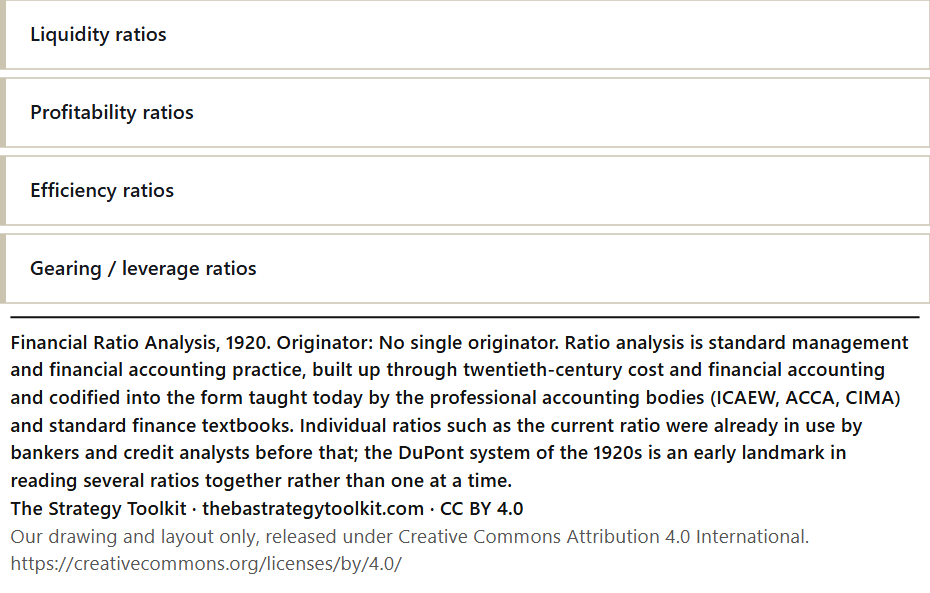
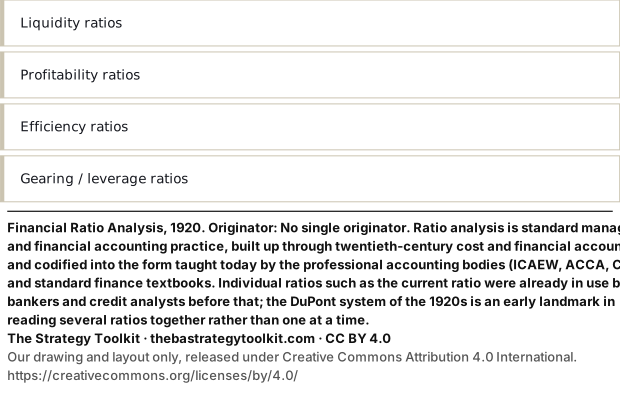
Originator: No single originator. Ratio analysis is standard management and financial accounting practice, built up through twentieth-century cost and financial accounting and codified into the form taught today by the professional accounting bodies (ICAEW, ACCA, CIMA) and standard finance textbooks. Individual ratios such as the current ratio were already in use by bankers and credit analysts before that; the DuPont system of the 1920s is an early landmark in reading several ratios together rather than one at a time. The framework itself is not ours to license, and the written entry behind this page, its worked example, critiques and sources, stays all rights reserved. The full licence position is set out in plain English.
Before you fill it in
A blank template is the easy part. The entry behind it covers how to run Financial Ratio Analysis properly, a worked example, the pitfalls real teams hit, and the situations where it is the wrong tool and something else would serve better.