Template · Finance
Unit Economics template
For checking whether each sale and each customer actually makes money, before you scale and multiply the loss. Leave it alone when you have too little history to know how long customers stay; three months of data is a guess with a decimal point. Instead Break-even Analysis and Cash Flow Forecasting until you have a year of customers; lifetime value needs a lifetime.
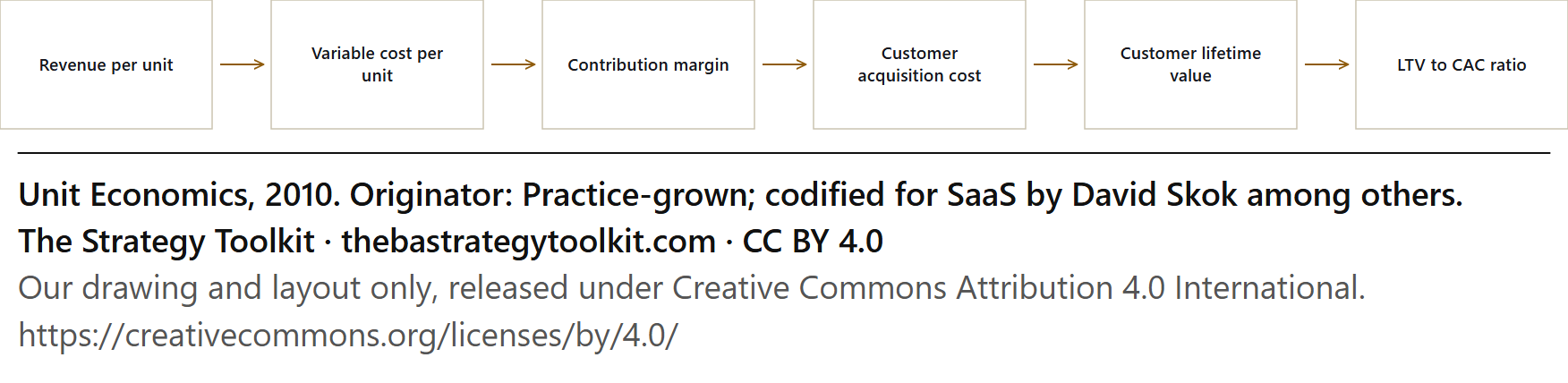
Download it
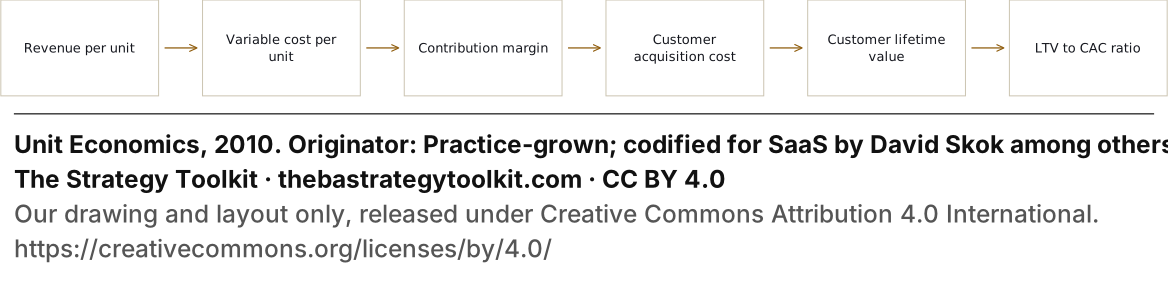
Nothing here asks for an email. The files are static and you can link straight to them.
Or work it through here
Work at the level of one customer. Enter monthly revenue and variable cost per customer, the fully loaded acquisition cost, and monthly churn. Contribution, lifetime value, the LTV to CAC ratio and the payback period compute below. Read contribution first: if the unit loses money, no acquisition efficiency can save it.
Inputs
Result
- Contribution per customer / month
- £37
- Expected lifetime
- 11.1 months
- Lifetime value (LTV)
- £411.11
- LTV to CAC
- 2.8:1
- CAC payback
- 3.9 months
What you may do with it
This sheet, meaning our drawing and layout of it, is released under Creative Commons Attribution 4.0 International. Use it commercially, put it in a client deck, print it for a workshop, adapt it. Keep the attribution line that is printed on the sheet and you have met the licence.
Originator: Practice-grown; codified for SaaS by David Skok among others. The framework itself is not ours to license, and the written entry behind this page, its worked example, critiques and sources, stays all rights reserved. The full licence position is set out in plain English.
Before you fill it in
A blank template is the easy part. The entry behind it covers how to run Unit Economics properly, a worked example, the pitfalls real teams hit, and the situations where it is the wrong tool and something else would serve better.